
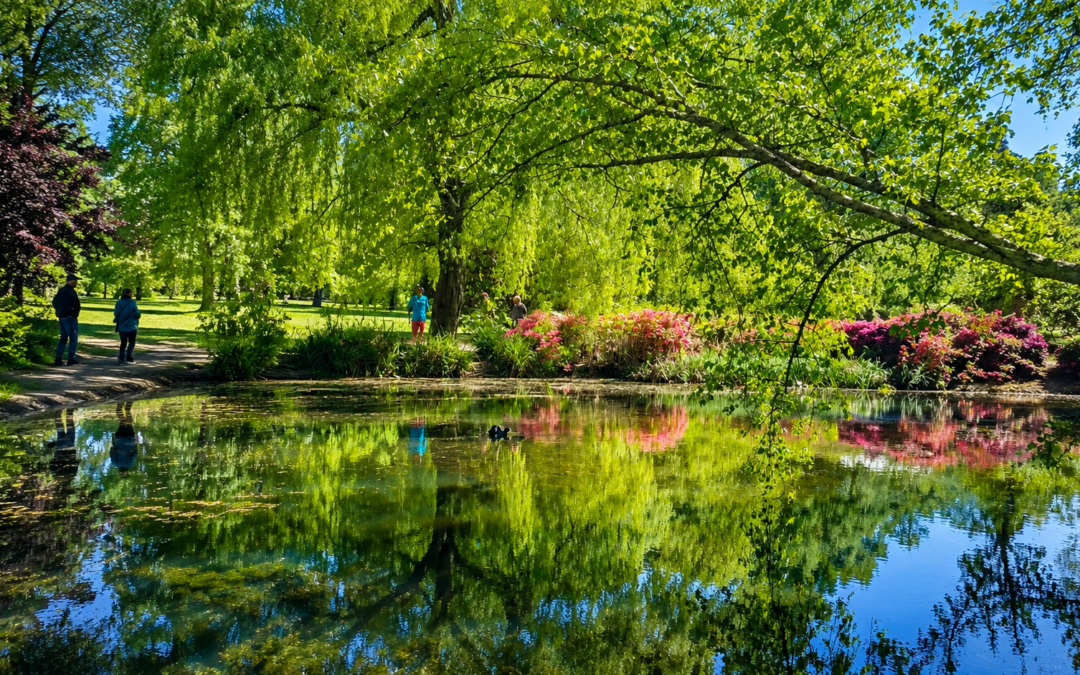
Some days turn out far better than you expect, without any real planning or pressure. Our visit to Richmond Park was one of those. What started as a simple drive became a slow, relaxed day surrounded by nature, with an unexpected highlight tucked away within it.
Driving through the gates into Richmond Park felt like the start of something special. I had no idea just how vast it is. What looks on the map like a park feels more like open countryside stretching on and on. Ray mentioned it was once a royal hunting ground, which made sense when you realise King Charles I created it in the 1600s, and suddenly it all feels a bit more grand.
It’s not somewhere you simply pass through. With a 20-mile-an-hour speed limit, you are gently forced to slow down, and that turns out to be part of the charm. Cyclists glided past us with ease, while walkers seemed to appear from every direction, all making the most of the space.
The deer were the real highlight. Herd after herd of Red and Fallow deer grazing or resting in the grass, completely at home. It is hard to believe you are still in London when you see them like that, roaming freely just as they have done here for hundreds of years.
There was such a lovely mix of people, too, from serious cyclists to families out for a gentle stroll. The whole place had a calm, unhurried feel, helped along by the ancient trees and wide open spaces that have been protected for generations.
After exploring the wide open spaces of Richmond Park, we made our way to a quieter corner we had heard about, not quite knowing what to expect.
Isabella Plantation
We had planned to head for the Peg’s Pond entrance, which we had heard was one of the best ways into the Isabella Plantation if you have mobility issues. In true us fashion, though, we missed the turning and carried straight on, happily driving along at 20-miles-an-hour for what felt like ages. It turned out to be about three miles before we realised we should probably have turned right quite a while back.
Rather than rushing to correct it, we pulled over at a kiosk and made the most of it, sitting in the sunshine with a coffee before turning around. It actually turned into one of those unexpected little pauses that you end up enjoying just as much as the plan itself.
Eventually, we turned around and headed back the right way, a little slower, a little more aware, and ready to see what we had come for.
Tucked away within Richmond Park is the Isabella Plantation, and stepping into it feels like entering a completely different world. After the wide open spaces of the park, this felt more enclosed, quieter, almost like a secret garden waiting to be discovered.
The Isabella Plantation was quite simply beyond words, so much more beautiful and immersive than we had imagined.
Created in the 1950s from what was once wild, boggy ground, it has been carefully shaped into a woodland garden that still feels natural rather than formal. Winding paths curl alongside streams, ponds and little clearings, with each turn revealing something new. At times it felt like we were moving from one little scene to another, a burst of colour, a clearing flooded with light, or a reflection trembling on the surface of the water.
As we wandered further in, the colours began to unfold around us. Not just the obvious bright bursts, but layers of them. Soft pinks blending into deeper purples, flashes of rich red, and pockets of white that seemed to glow against the green. Some corners felt gentle and hushed, while others were so vividly alive they made you catch your breath.
And then there was the scent.
It arrived before we noticed it, light and faintly sweet, threading through the air between the trees. It came and went as we walked, present for a moment, then gone, then drifting back again without warning. More than once, we stopped mid sentence, turned to each other and said, “Can you smell that?” There is something about a fragrance you cannot quite catch that makes it linger in the memory far longer than one that overwhelms.
What surprised me most, perhaps, was the stillness. Even with others around us, and there were others, the plantation never felt crowded or hurried. The soft murmur of conversation, the quiet movement of water threading through the streams, the occasional lift of birdsong overhead, it all blurred together into something that made you slow down without ever deciding to. Time moved differently in there.
Benches appeared at every turn, placed just where you needed them, inviting you to simply be for a while. Some visitors had brought picnics, their blankets spread across patches of sun warmed grass, and we both said the same thing at the same moment: we should have thought of that. Little groups sat chatting softly. Others were stretched out fully, soaking up the sunshine without a care in the world.
We found a spot of our own and stayed longer than we had planned. Watching the sunlight shift across the flowers. Listening to that easy hum of voices around us. People drifting in and out of the dappled shade like figures in a painting.
It was a simple afternoon, nothing grand, nothing remarkable on paper. But some moments settle into you quietly, when you realise you are exactly where you are supposed to be, doing absolutely nothing in particular, and that is more than enough.
We left feeling relaxed, a little slower, and already talking about coming back, perhaps next time with a picnic.
We were visiting the area in our motorhome and stayed at the Walton on Thames campsite.